
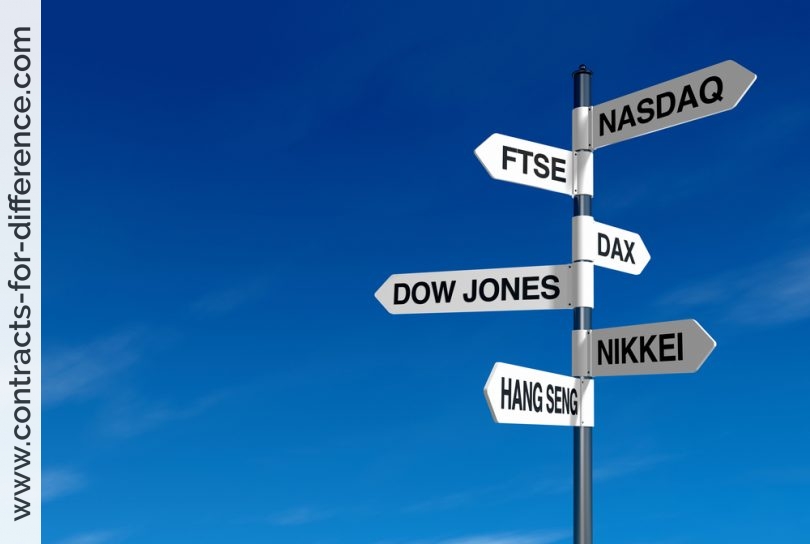

Index CFD trading provides a great way to speculate on the performance of each overall stock market, as opposed to selecting individual stocks and shares. In fact index CFDs are often viewed as being less of a risk than trading individual stocks, as you are spreading your risk across the whole market rather than on a single company. This allows for diversified exposure as most of the factors that affect individual companies are taken out of the equation. If you believe the FTSE 100 in the UK is going to do well, there’s a CFD that allows you to profit when it does; if the Dow Jones Industrial Average looks set for another fall, you can trade that for a profit too.
By taking a CFD position, a trader is essentially agreeing to exchange the difference in price of an index from one time period to another. Index CFDs are available to cover all the key indices around the world, which allows the trader in one country to take part in the world markets. In addition to the UK and US markets, CFDs cover the Aussie 200, the far Eastern markets, the German DAX and many others.
So, why should one trade world indices CFDs? To start with stock indices are a benchmark of the market performance in each country and it is quite easy for an investor to familiarise oneself with an index since they are constantly in the news headlines. Thus index CFDs are useful in that they allow easy access to an otherwise unfamiliar market without having to worry about clearing fees in the respective exchanges or the need to stock pick. Moreover, most main indices are based on baskets of blue chip securities on the exchange and are thus considered good measures of the current market sentiment. Thus, when you take a position on an index, you are effectively investing in the performance of these blue chip shares.
Most short-term traders seem to prefer to focus on the main stock market indices like the FTSE, Dow and S&P as these respond better to technical analysis and price action – in effect most of the times you will find that the indices are moving in trends contained in well-defined support and resistance levels. Popular markets tend to be the FTSE 100, Dow Jones, S&P and Germany’s DAX index, the last of which ranks 4th. Other popular indices tend to be the France’s CAC-40 and Japan’s Nikkei 225. It is curious to see that the DAX ranks 4th place by order of popularity but this could be attributable to the fact that it moves more than the FTSE 100 which most day traders find attractive.
But just what is an index CFD? It is a form of Contracts For Difference (CFD) that allows investors to track and trade the underlying index, although prices may differ from the actual index levels. Index CFDs are intended to mirror the best estimate of the present cash price of the market and so the quotes are taken from the corresponding futures contract with a fair value adjustment. The adjustment is needed because while the financing fee for the open-ended CFD is charged separately each night, but the futures price reflects the remaining cost of funding to the contract expiry date.
There are several advantages to trading index CFDs, particularly if you want to take part in world economics since indices are highly responsive to economic news. It may be impossible for you to find time to analyze individual companies around the world, but if you think the Nikkei index is looking good, it is simple to take a position directly on the performance of that market. This makes them well suited to trade the fundamentals. A particularity that most traders find attractive is that as opposed to a share CFD, an index CFD can’t go to zero. This is because an index CFD is a benchmark of the biggest stocks quoted on an exchange. Thus, all of those stocks would also have to go to zero for this to happen which is highly remote a possibility.
When trading indices you don’t necessarily have to analyze each individual company; by definition an index already provides diversified exposure and this reduces the possibility of wild movements based on sudden news releases. For instance the Russell 2000 provides even more diversification than the Dow or S&P index as it is made up of 2000 USA companies so providing a better picture of how the USA enonomy is faring. In contrast to trading individual shares, being able to long and short an index with CFD allows speculators to trade on the price movements of an entire stock index as a whole. This is definitely a hassle free and cheaper way to invest in a basket of stocks that instantly diversifies your investment portfolio across a few sectors. Also, besides sectorial diversification, geographical diversification is another reason why investors look to global index CFDs. By trading in, for instance, the Wall Street Index CFD, UK investors are effectively exposed to the USA market in a cost-effective manner irrespective of whether they have a bullish or bearish view on the market.
In addition, most index markets are traded round-the-clock so they are much less prone to suffer big gaps like individual stocks which means there is less scope to use guaranteed stops with these markets. Another advantage enjoyed by all CFDs is the amount of margin available when trading. On the major indices this would typically be around 1 to 3% of the value of the index although one also need to reserve some additional funds to cover running losses. A margin of 1% means that if you had $1000 in cash you could trade $100,000 on an index CFD. The value per point for the CFD will be measured in the local currency, such as the dollar for the NASDAQ. This may be the most economical way of getting some exposure to the ups and downs of the world economy.
Providers will normally price the index CFDs by taking the futures and making a fair value adjustment to establish the cash value of the index. They will then add a little extra margin to the bid-offer spread to make up their commission. Each contract is equivalent to an exposure of one unit of the base currency per index point. The minimum trade size is one CFD, which for the FTSE 100 is equivalent to an exposure of £1 per each index point (so buying a FTSE 100 CFD would be the equivalent of putting in £5,500; assuming that the FTSE is at the 5,500 level). Typically you will not pay a commission for trading index CFDs although there will one or two points added to the spread. The broker or CFD dealer will quote you bid and ask prices, and the difference between these, which is called the spread, is where he makes his profit. The broker does not need to underwrite the deal or risk his own money, he just has to match up buyers and sellers, that is traders who want to go long against those taking a short position. It is equally easy to go short on the index, to profit from a falling value, as it is to go long. The only other cost to consider apart from the spread is the overnight financing charge since since you will be charged a small fee for positions held overnight. This is based on LIBOR but at current low levels of interest this amounts to less than 1 index point on the FTSE.
As you are trading on margin, each day that you hold your position your account will be charged for notional interest. Effectively, you are buying the ‘basket of stocks’ that makes up the index, and profiting or losing from the change in prices. Even so, you do not ever take ownership of any shares, which means that you do not get involved with stamp duty or capital gains.
As an example, say that you think the Dow is about to move up again. The current price may be 10070, so you may find that the CFD is quoted at 10068 to 10072. This means that a CFD on the Dow would represent an exposure of about $10070. You could, for instance, buy a long position at 10072, and profit from any movement above that figure. The cost of the position would be just over $300 at 3%. If the Dow goes up to 10150 you will profit by $78 giving you more than 25% profit on your original investment. Another attribute of trading index markets is that in some cases it is actually possible to trade after-hours or when the markets are closed. This provides you the opportunity to take a perspective on how the index will perform during the next trading session and in such cases the prices will be based on both the provider’s ‘book’ and on what is happening in the stock exchanges that are still open at the time.
Besides diversification, World Indices CFD can be used as a hedging tool. For instance, if you have a number of FTSE 100 stocks in your portfolio and fear that the markets are about to experience a general decline, instead of selling them you could take a short position on the FTSE 100 and thus reduce your downside exposure without selling the stock.