

The FTSE quarterly reviews are also followed closely by CFD traders. Trading on index changes involves trading a stock on the basis of a company’s ascent into, or demotion from, a benchmark index. For instance, the FTSE 100 index is reviewed every quarter to ensure it keeps representing the 100 largest London listed companies by market capitalisation. Each time there are usually a number of stocks that have lost value and hence get relegated from the index with a similar number being promoted. A majority of tracking and pension funds seek to replicate the FTSE 100 or FTSE All-Share indices so changes to these indices can be more important than say the FTSE 250. The logic behind the index trading strategy is that a company whose stock is likely to be included in one of the major benchmark indices is likely to get more buyers from these index trackers and will thus experience some upward movement as index and pension fund managers buy into the stock to maintain correlation with the relevant index. So private traders would buy the most likely companies that are due for promotion in the expectation that stock prices of these companies would be sustained on admittance due to fund managers having to buy the stocks. Of course the reverse is also true and a company that is in danger of being demoted from an index may experience a fall in its stock price although care needs to be taken here as this development would have been anticipated weeks ahead of exclusion and a number of fund managers may have already reduced their holdings.
For example on June 2001, it was announced that Railtrack would be removed from the FTSE-100 to be replaced by Next. These changes would take effect after the close of business on Friday June 15th. The two-day charts below illustrate the dramatic short-term effects that tracking funds can have on a stock price. By dealing in the auction the tracking funds can ensure they are buying the new constituent at the same price that it will be entering the index, and selling the leaving constituent at the same price that it will be removed from the index, thus guaranteeing close tracking.
However, CFD traders took advantage, typically buying Next during the Friday, selling their position in the auction at the high of the day at 973p and then selling short more Next also in the auction. On Monday, Next’s first day in the index, the traders were about to buy back their shorts between 925p and 955p. A similar strategy in a reverse sense was applied to Railtrack, the stock leaving the index. CFD traders sold the stock short during the Friday, bought their short back in the auction at 298p, the low of the day, and then bought again, running a long position over the weekend. On the Monday, the stock rallied throughout the day allowing the stock to be sold out anywhere up to 325p.

Note: those examples are taken from the past on purpose. The examples are only provided as an illustration and are not intended to be a tip to buy into the mentioned companies.
Stock Reclassifications and Re-ratings
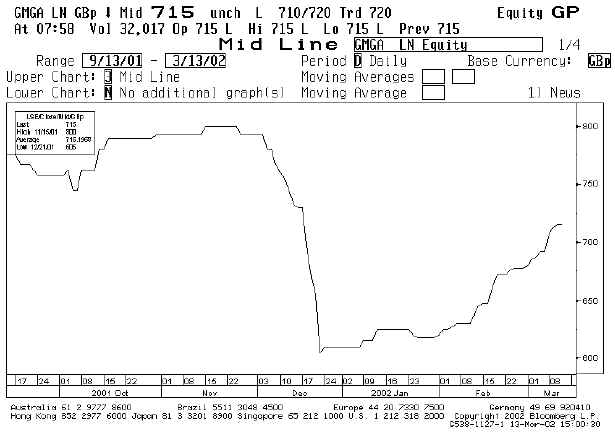
The FTSE 100 Quarterly reviews have been well documented above. In addition, the FTSE All-Share Index is reviewed annually in December, although quarterly reviews can occasionally take place when a stock has recently joined the market. As the reviews approach you can check the market capitalisations to see which companies are likely to be promoted or relegated. It is important to remember that tracking funds generally follow the FTSE 100 or the All-Share Index, FTSE 250 Index changes are less significant. A good example is shown below where Glenmorangie was booted out of the All-Share due to liquidity issues. Tracking funds were obliged to sell the stock, having a significant impact on the share price. Over the next couple of months, a good recovery ensued. The changes to the Index are effective on expiry day, usually the third Friday of the month, so the strategy is to sell the stock after the announcement but in advance of its removal and then buy the stock after its removal, anticipating a recovery in share price. Other opportunities can occur when a stock is reclassified from one sector to another, with that sector enjoying a higher p/e ratio or if a company were to raise extra equity which would also push tracker funds to increase their holdings to maintain their weighting in that particular share.